

Crystallised Titanium Strip
Price range: R175.00 through R2'000.00
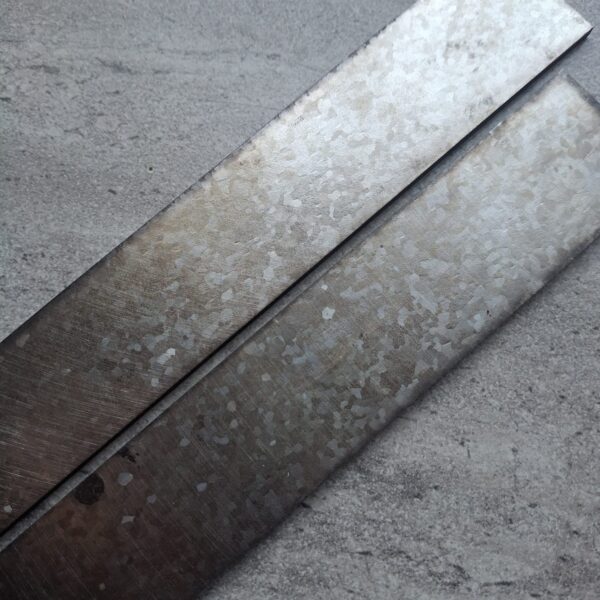
What is Crystallised Titanium? Grade 5 Titanium that looks much nicer.
Picture a white‑hot titanium bar sitting at roughly 1 200 °C. Instead of snapping the heat off, dial it back gradually. The instant the metal drifts below its crystallised point, tiny solid “seeds” — the first nucleation centers — begin to form. Those sites act like seeds, and from each seed a tiny metallic tree—what metallurgists call a dendrite—starts growing. Let the cooling rate stay gentle and you’ll see primary branches, then finer secondary arms, spreading just like frost on a windshield.
Here’s the neat part: titanium doesn’t keep the same crystal lattice all the way down. Above about 882 °C it sits in the β-phase (body-centred cubic). Below that, it shifts into the α-phase (hexagonal close-packed). As the solidification front crawls, parts of the metal are still β while others have already gone α, so every dendritic arm locks in a slightly different orientation. Where those arms meet, they knit together into visible grain boundaries—tiny ridges that catch the light and give the finished surface that lightning-bolt shimmer.
Why does any of this matter beyond the cool look? Those extra grain boundaries boost dislocation density, which nudges hardness up a notch and tweaks how the metal handles thermal expansion. In other words, the pattern isn’t just eye candy; it subtly changes performance.
Knife makers love it because a knife scale blank can come out both prettier and a touch tougher. Science and art in one bar of metal—hard to beat that combo.
PLEASE NOTE!!!
SOLD PER: 4,3mm x 40mm x 25mm OR 4,3mm x 40mm x 300mm
Description
Colouring Process of Crystallised Titanium: Heat Treatment and Electrochemical Anodising
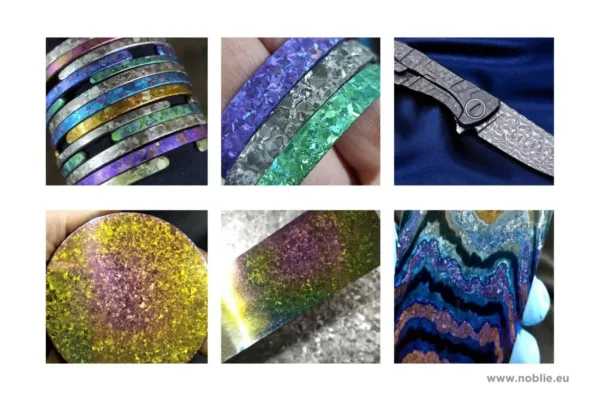
Crystallised titanium can be coloured either by controlled heating in air or by anodising in an electrolytic bath. In the heat-treatment method, clean the piece and heat it in a furnace or with a torch in air at specific temperatures (°C) to produce interference colours:
- ≈385 °C: pale gold–straw
- ≈412 °C: purple
- ≈440 °C: deep blue
- ≈510 °C: light green
- ≈565 °C: red-purple
- ≈648 °C: brown-gray
- ≈925 °C: green-blue
These colours arise from successive titanium-oxide phases (TiO₂, Ti₂O₃, etc.) forming thin-film interference layers Wikipedia.
For electrochemical anodising, immerse the titanium part as the anode in a 10–20% H₂SO₄ (sulfuric acid) bath at 20–22 °C. Apply 15–110 V DC (depending on the desired hue) at a current density of 15–30 A/ft² (≈1.5–3 A/dm²) for 1–5 minutes. Typical colors include:
- 20 V: purple
- 30 V: blue
- 60 V: orange
- 90 V: blue-violet
- 110 V: green
The exact hue is controlled by oxide-layer thickness, which grows approximately 1.7 nm/V, producing vivid, dye-free finishes 3ERP.
Applications of Crystallised Titanium
Applications of Crystallised Titanium and Timascus encompass a broad spectrum, ranging from functional tools to high-end fashion accessories, highlighting its versatility and unique appeal:
Knifemaking. The knife community grabbed crystallised titanium first, and it’s easy to see why: lightweight crystallised titanium scales or bolsters that gleam like fractured ice, yet still hold up to everyday carry abuse. Makers will often plasma-etch or low-voltage anodise the dendritic surface, turning each ridge into a micro-rainbow that sets off a mirror-polished blade.
Jewelry and wearable art. Ring blanks in Grade 2 crystallised Ti have become a staple on lathe-turning forums. The material machines cleanly, handles a high lustre, and — thanks to its biocompatibility — won’t set off nickel allergies. Anodising lets artists “paint” across the crystals in gradients of teal, violet, and gold without any dyes or plating.
Exclusive watches. A few boutique watch brands have begun using crystallised titanium for bezels and case backs. Besides the head-turning texture, the higher surface hardness shrugs off pocket scratches, and the oxide film resists sweat better than stainless steel.
(REFERENCE: https://nobliecustomknives.com/crystallized-titanium/)
Additional information
| Weight | .3 kg |
|---|---|
| Size | 4,3mm x 40mm x 25mm, 4,3mm x 40mm x 300mm |
Related products
-
- Out of Stock
- Handle and Bolster Material
BRONZE
- Price range: R462.00 through R945.00
- Select options This product has multiple variants. The options may be chosen on the product page
-
-
- Sale!
- Handle and Bolster Material
Handle and Bolster Pins Various
- Price range: R3.00 through R130.00
- Select options This product has multiple variants. The options may be chosen on the product page
-
- Handle and Bolster Material
Tufnol
- Price range: R6.50 through R155.00
- Select options This product has multiple variants. The options may be chosen on the product page


